
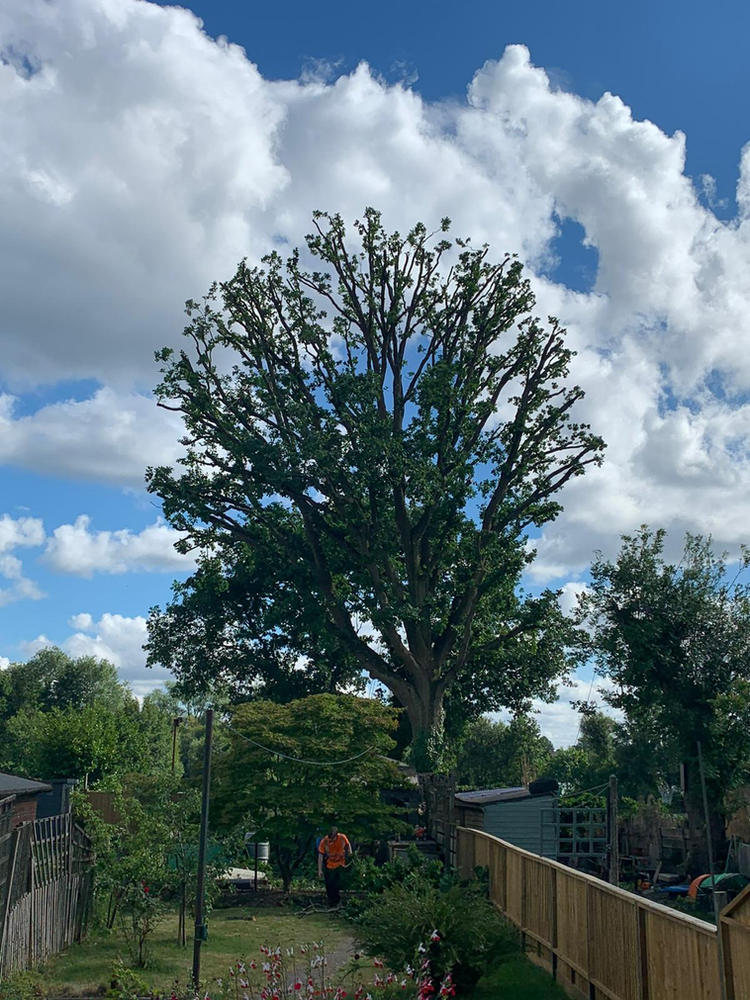
Crown reduction and pruning.
Taking size and weight out of a tree without turning it into a hat stand.
A crown reduction shortens the branches of a tree to reduce its overall height and spread, typically by 15 to 30 per cent. Cuts are made back to a suitable side branch so the tree keeps its natural outline and can seal the wound. It is not the same as topping, which cuts through the main stems, leaves large open wounds and produces weak regrowth.
Reduction, thinning and lifting are different jobs
A reduction makes the whole crown smaller. It is what you want when a tree has outgrown its space, is overshadowing a garden, or is heavy enough that you are worried about it in a gale.
Thinning removes a proportion of the smaller branches throughout the crown without changing its size or shape. It lets more light and wind through, which helps if you are growing anything underneath or if the tree acts like a sail in winter.
Crown lifting removes the lowest branches to raise the canopy. It is the fix for a tree you cannot mow under, walk under, or get a van past.
Why topping is not on our list
Topping means cutting the main stems back to stubs. It is quick, it is cheap, and it is the single most damaging thing you can do to a mature tree. The wounds are too large to seal, decay gets in, and the tree responds by throwing out dense clusters of weakly attached shoots that are more dangerous in five years than the original branches were.
BS3998, the British Standard for tree work, does not support it. If someone quotes you to top a healthy tree, get another quote.
When to prune
Most broadleaf species can be pruned through the dormant season, roughly November to March, and that is usually the tidiest time because there are no leaves to clear. There are species exceptions worth knowing: prune cherry and plum in summer to reduce the risk of silver leaf, and avoid pruning birch, maple and walnut in late winter when they bleed sap heavily.
Nesting birds are the bigger constraint. It is an offence to damage an active nest, so between March and August we check the tree before we start and will postpone work if we find one.
The short version
Common questions
How much can you take off a tree?
Usually up to about 30 per cent of the crown in one go. More than that stresses the tree and triggers heavy regrowth. If a tree needs more than that, it is better done over two visits a few years apart.
Will reducing my tree kill it?
A properly specified reduction will not. Cuts are made back to growth points the tree can seal, and the volume removed is kept within what the species tolerates. Topping is what kills trees.
How often will it need doing again?
On a vigorous species like lime, willow or poplar, every three to five years. On a slow-growing oak, considerably longer. We tell you what to expect for your specific tree.
Not sure if this is what you need?
Describe the tree and what is worrying you about it. We will tell you what the options are and roughly what each one costs, including the option of doing nothing.